Wednesday, 7 October 2015

Tuesday October the 6th; in transit

I had a really rather self-indulgent breakfast, involving local honey and fresh orange juice.  I've been staying B&B here, and Mrs Kondylis does an excellent breakfast; but of course, that’s my carb allowance for pretty much the whole day, blown in one blast.  Very good though.

I packed, found I had just missed the bus to modern Corinth and had an hour to fill before the next one, so I went for a stroll. 
A last look out over the ruins of Roman Corinth

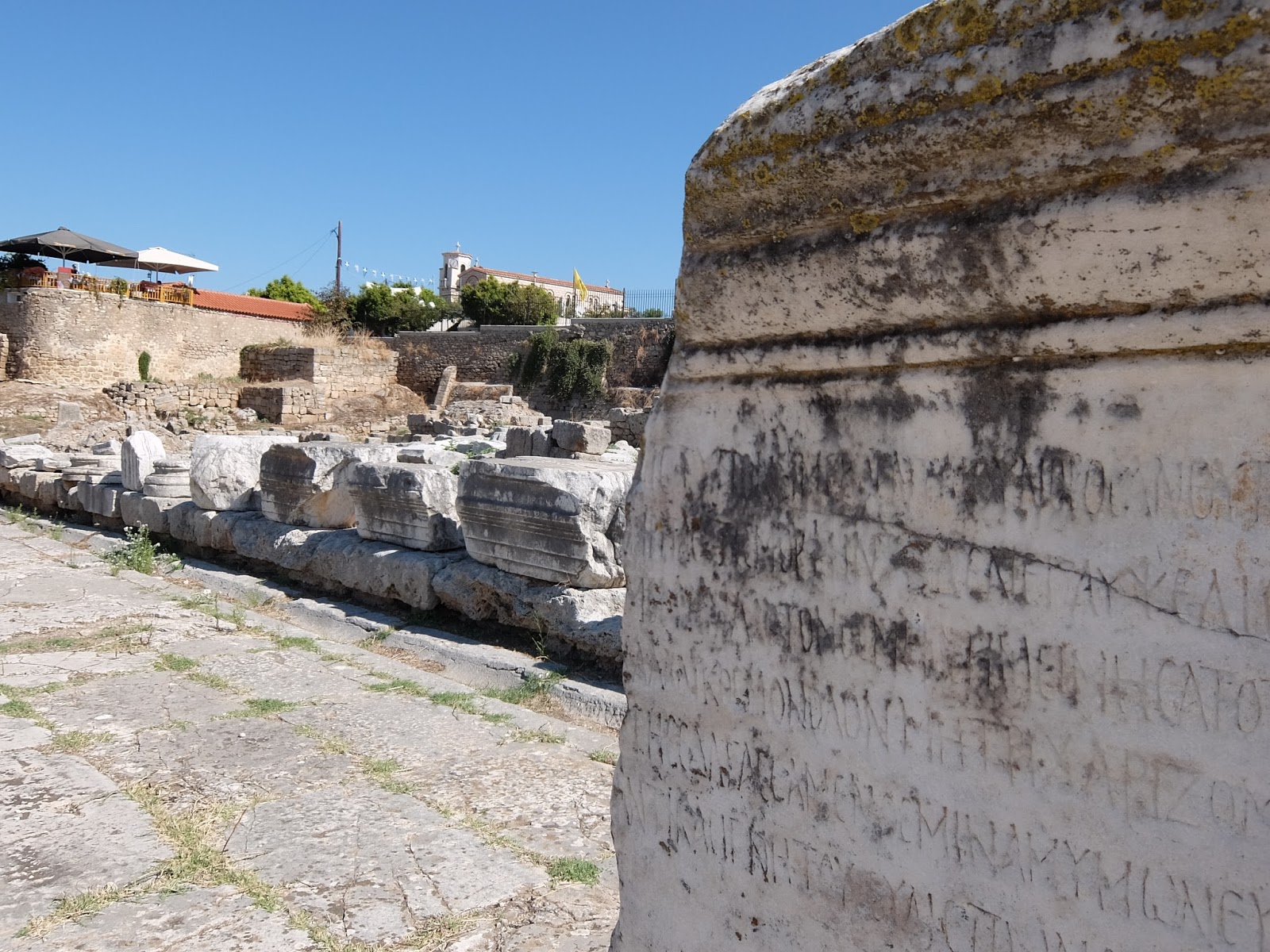
Outside the church is a big marble pillar with this quotation from one of St Pauls's epistles to the Corinthians, in Greek and English

..and this delightful chap was sitting at the foot of the text!
When I came back for my luggage forty minutes later, Mrs Kondylis insisted on giving me a bottle of their own home-grown olive oil.  I’ve managed to cram it into my case and will look forward to the taste of Korinthos in London.
Mr and Mrs Kondylis were super and so were their rent-rooms.  I’ve been eating in the evenings at their little taverna downstairs, too; their food is simple and fresh and they had nice house wines.  They don’t do a large range of dishes, perhaps three starters and three main courses, a choice of salad or horta; and when you ask what’s for supper they list it instead of bringing you a menu.  I’ve eaten very well there. 

I was sad to leave Archaia Korinthos.  It’s been wonderfully peaceful – though of course with various rural noises like cockerels and church bells and tractors and goats.  There’s very little light pollution, too, so that at night I could see masses of stars, even quite faint ones like the Pleieades and just a suggestion of the Milky Way.  I’d like to go back there some day, maybe visit Lechaion, Sikyon, Kenchraeai, Isthmia...
There’s always the next trip.
Lechaion, seen from the bus; the marram grass-covered sand dune in the middle distance covers some of the ancient harbour works, and to the left of it is a rather stagnant-looking lagoon that is all that's left of the artificial port the Romans built

Meanwhile on this trip, I got the bus to Corinth, took a taxi to the main bus station (because for some perverse reason the local buses all run from a totally different part of town to the long-distance ones), bought my next ticket, and took another bus to Athens.
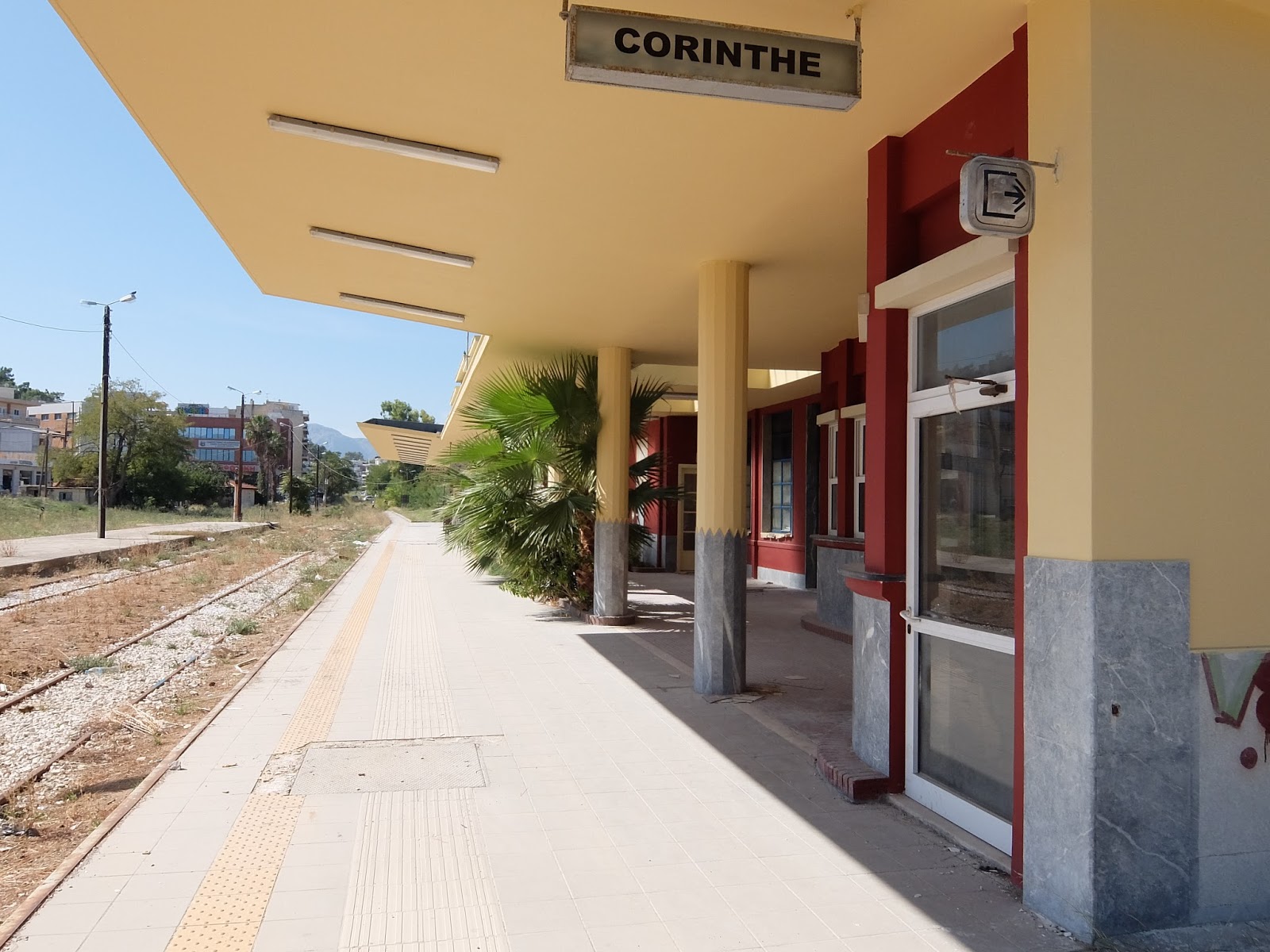
Bizarrely, the long-distance bus terminal is next door to the abandoned railway station (the new railway line has a different route).  This is the place where I got stuck for ages, 26 years ago, with no breakfast.  I'm guessing it closed fairly recently, since it doesn't seem to have changed much, apart from no more trains going through, and of course the palm on the platform has grown a fair amount

The eastern end of the Corinth Canal, seen from the bus

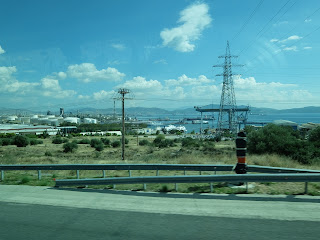
The road to Athens is mostly coastal; some of it is really scenic; open country and views out to sea near Megara

...and some is less so; modern docks and industrial district near Elefsina

I’m back in the Athenaikon Hotel, in another little single room with a comfortable bed and tiny bathroom and a pile of clean white linen and towels.  Athens feels tremendously bustling and busy after the rural quiet of Archaia Korinthos, but at the same time it’s nice to be back here. 
Passing by the Panathenaic Way in the early evening

Beautiful crystalline strata in a block of the steps of the ruined Eleusinion

A simple graffiti, "I love you"...

Monastiraki Square, getting busy as the evening comes on

I've been out for a stroll and I just had a very tasty supper at Oinoploeion - the grilled mushrooms were delicious!  Tomorrow is my last day; on Thursday I fly home.  What a thought.

Tuesday, 6 October 2015

Monday October the 5th. In the high places

Acrocorinth.  The famous fortress, the "Fetter of the Peloponnese", which stands over Archaia Korinthos and the Roman ruins, 566 metres high (some 1800 feet in old money).

I can say it now; getting there was one of my biggest objectives, and I've accomplished it. 

And it has been a wonderful day; one of those days that exceeds your wildest expectations.

I took the advice of Magdalini, the nice woman at the Tavernaki tou Gambrou café, and made an early start.  Reading tripadvisor reviews and tips had just made me nervous; the sensible suggestion of someone who actually lives here was far more reassuring.  Besides, now I'd told someone I was planning to do it, I was committed; I had to give it a go.

But a four km uphill walk, followed by exploring a large castle?  Followed by another 4 km downhill?  For a plump middle-aged diabetic who has had foot trouble in the past?  I admit I was a trifle unsure whether I'd even make it to the top. 

I did know however that if I walked up to the village square and took a taxi I'd always have the knowledge of having been a wimp and not even tried!  8 km is only 5 miles, after all, even if it is all hilly.  Pull yourself together, Dent, I told myself.

I set off at 8.30 and was there by ten.  Finally left at 1.30, had a snack at the café by the lower gate, and was back in Archaia Korinthos at around 3.40 eating a very late lunch (bifteki stuffed with cheese, and a large salad - delicious!). 

So - what's the walk like, and what is there to do and see, up on the rock of Acrocorinth?

It was a lovely walk up.  The road climbs steadily but never particularly steeply, it swings around the foot of the rock, slowly working upwards.  I had a lovely bright morning for it, and the views got more and more spectacular by the minute.  After half an hour I was taking photos, thinking "I know that soon, as I get higher, this will look like nothing - but it's so beautiful already!" 


There were wildflowers in the verges and bees buzzing, and little birds flying by or sitting on telegraph wires.  A kite wheeled slowly above one of the valleys on a morning thermal.  There were streaks of faint high cloud in a deep blue sky, and whenever my route took me out of the shadow of the rock and into the sunlight, it was already really hot.


There was a moment when I'd been tramping steadily for a couple of hundred metres round a long curve, and I stood aside to let a car pass, and since I had paused I looked all around me.  Right there, right above and behind me, was the whole of the great triple rampart and the three gateways, with all their flanking bastions and towers, backlit by the morning sun and looking like something out of a fairy-tale or a stage set.  It was huge, and much closer than I'd expected; and the effect of seeing it so unexpectedly was simply magical.  I stood with my mouth open for a moment and then I'm afraid I just swore.

The climb up by road to the entrance was perfectly manageable; the real hard work started once I was inside.  I thought Palamidi occupied a hilly site; Acrocorinth is much, much hillier.  Coming in through the third and final gate you are confronted by a kind of amphitheatre of rock and ruins, all crowned by battlements silhouetted against the sky.  In the Middle Ages there was a whole small town up there, with four mosques and six churches.  Now in the main there are just broken walls, and long steep paths to climb, some of them dusty and rough as goat-tracks, others cobbled, and then polished shiny-smooth.  I started climbing again.
The first gate - Venetian & Ottoman

Classical stonework at the base of the second gate (mediaeval)

Approaching the third gate (Byzantine on a Classical base)


Most of the front of the right hand tower dates from the 3rd century BC; you can see how different the masonry looks

Panorama from just inside the third gate
First of all, yesterday, I’d looked up from the ruins down below and not quite believed I’d even get to the gate; then I’d started walking and found it okay.  But even now, when I’d got as far as the inner bailey, inside the third gate, I saw how much further there was to climb, and for a bit I wondered if I’d make it all the way right to the top.  The highest point of the rock, where the famous Temple of Aphrodite stood in Classical times.

Of course I did make it.  I quartered the whole place.  The interior of the castle was so fascinating that I didn’t even think about being tired until I’d been there a couple of hours.
The interior of the little church of Agios Dimitrios, in the inner bailey

The interior of a ruined mosque

The Upper Peirene Spring was closed for renovation

And these four chaps were working there; they were trying to move a large boulder with levers and wedges, and a fulcrum made of a pile of rocks.  A lot of cursing was going on

The path up to the summit (note oddly near-looking cloud!)

The Temple of Aphrodite was served, famously, by a long tradition of what the guidebooks call “sacred prostitution”.  In English that’s a pretty unlikely yoking of concepts, and I wonder if the original words might have a slightly different nuance if one knew all their connotations.  I’d certainly prefer to think of them like the Heirodules of the Devourer, in Kate Elliott’s Crossroads novels, rather than the shabby and fairly sordid image the word “prostitution” conjures up.  But Corinth’s reputation was for sexual licence, at least in Roman times; it’s apparently the origin of the Georgian slang “Corinthians” for loose women...

After it was a temple, the topmost peak of Acrocorinth was occupied by a Byzantine church and then by a mosque.   Now, there’s nothing up there but jumbled ruins, and I should imagine it takes a very expert eye to distinguish the remains of the different buildings.   One set of foundations is at a slightly different angle to the rest, so I imagine that was the mosque.  But it’s a quiet, clear remainder in visual form of the passage of time and the transience of all our systems of thought; all beliefs, all faiths and certainties, all passing in time.  Everything flows, nothing is fixed. 

Climbing higher

Almost at the top

Three different phases of masonry, all in ruins 

The view north
I stood looking out, and down, and all around me, at the view.  Which was phenomenal. 
I’d had a vague idea that I might have some profound thought, if I got up here; or that I might feel moved to make some profound prayer.  In the end, neither happened.  I felt a deep calm that didn’t take shape into anything more precise; just a kind of happy emptiness.  My head was full of heat and light and distance.  I just stared. 

There had been a friendly German family up there when I arrived, taking photos and eating dried fruit, but they left fairly soon and for the next forty minutes I just sat there on my own, looking out at the world, in complete silence.
Eventually I geared myself up to take my own photographs.  I did my first-ever 360-degree panorama (see above) and of course a selfie.  I’ve learned my lesson since beheading my own portrait back in Athens, and now I always check the results when I try to get a picture of myself.  I managed to get two decent shots of me, and three headless.  It’s a good thing the scenery was more photogenic than I am.

To the west, I could see out past ancient Sikyon, and over miles of the Gulf of Corinth; across the water the mountains of Boeotia receded to north and north-west, like mountains in a painting, gradually bluer and softer with each further layer of distance until they blended with the sea and I could not tell what was solid and what air, and only the faint pallor of the clouds catching on the highest peaks gave away that there was any land there at all.  I was probably seeing most of the way to Delphi, had I but known where to spot it.

Directly below lay the neat street grid of modern Corinth, and the green shape of the Isthmus, with the western entry to the Canal and a small ship just coming through.  If I’d been looking down in ancient times I might have seen a ship being dragged along the Diolkos; or even the teams of navvies and prisoners of war who the emperor Nero set to work trying to excavate a canal (the attempt stopped when he died; Pausanias is faintly smug about the fact the Peloponnese was still part of the mainland).  To be honest the photographs really don't capture it at all...

Off the other way, east, there was the same spectacle of receding blue hills and mountains and luminous sea, plus a few islands for variety.  Once people used to report being able to see the Acropolis from here, but these days the smoggy Athens air has something of a masking effect.  I could tell where Athens was, but by the sight of the nifos, the cloud over the city, not the Parthenon.  Beyond the cloud, the silhouetted hills sharpened again and rose, and receded slowly towards a single far high crest like a beacon hill.  Could that have been Sounion? 

In her great novel “The Last of the Wine”, Mary Renault has Alexias and Lysis come up here, just before the Isthmian games, and Alexias, who has good eyesight, can see both the sunlight glinting on the spear of Athena Promachos on the Acropolis, and the white columns of Sounion in the far distance.  That image has always stayed with me, the two young men standing here gazing out at their world.

If you’ve never read any Mary Renault, do give her a try, incidentally.  “The Last of the Wine” is not just a great historical novel, it’s also a great war story and a great love story.  I know they were only fictional people, but Alexias and Lysis walked with me on this trip up Acrocorinth just the same.  Just as Nikeratos (protagonist of “The Mask of Apollo”) goes with me into every ancient theatre I visit.  One day, perhaps, I’ll have a Mary Renault holiday, and follow her characters’ footsteps.  Though Nikeratos does get about a bit, being a touring actor; I’d need more than a month to follow him around the ancient world!

In the end I did say a prayer, and I poured a small libation, though I only had water to offer.  It seemed inappropriate not to, in a place of such ancient sanctity, and one that was never as it were on the high street, never easily popped-in-to.  I tipped out some of my water, and then drank a little myself, and I gave thanks to whatever are now the spirits of this place; for this trip, for everything that is beautiful and interesting about the world, for all the good people I’ve met and all those I’ve known in the past, including those who could no longer be there with me except in my mind. Finally I said “Thank you for my life” and I felt as full as I’d felt empty a few minutes earlier.
Seeing it written down, now, I think “Crikey, that looks as though I think I’ll be dead soon!” – and it isn’t like that at all.  I feel a lot more alive than I did a year ago, and ready for whatever comes next in a way I haven’t done in years.  And I am grateful and glad of this, and grateful beyond measure for this life, pathless though it has been at times and difficult.  I have seen and done so much with my time.  I’m likely well past my mid-point in life.  It seemed right to give thanks, for all the road so far.

On the way down I passed a group of trees, short, wind-shaped things that appeared to be dead; and I suddenly noticed that in fact they all had tiny buds, just starting to swell and go green, in the axil of every twig and leaf joint.  Once again, there’s that miracle, all the life returning now the rains have come.  It never ceases to move me.

At the third gate, on the way down

I stopped at the cafe just outside the outer gate and had a “tost”, that eternal Greek snack food of cheese grilled between two slices of sandwich loaf; not a great lunch, but a very holiday-ish one.  Eaten in front of another magical view.


Then I walked downhill steadily for an hour and a bit.  I did have slightly quivery legs by the time I was back at Archaia Korinthos.  I stopped a few times; to take photos, to prospect around the site of the shrine of Demeter and Kore,  once to go behind an olive tree, and once to watch a tortoise in the undergrowth on the verge.  My seventh tortoise here, I think? 
Looking up again as I leave

Of course a photo can't capture the wonderful smell of a fig tree in full sunshine...

Olive groves in the afternoon sun


A great walk, a great castle, a moment of complete peace of heart; a good day.

Monday, 5 October 2015

Sunday 4th of October; in the ruins of Roman Corinth

I was woken at dawn, by sparrows twittering, church bells ringing, and cockerels.  I slipped out onto the terrace to take photos of the sunrise; but then, I'm afraid I slipped back into bed and did a Sudoku before getting up properly and showering.  So in the end I was later getting going than I'd meant to be.


The gradual progression of dawn across the sky, until the eastern face of the Acrocorinth is lit up suddenly by the first rays of sunlight

Still a bit tired after my journey here, I suppose.  That's one of the things I've learned from this trip; I find travelling tiring, and that's okay.  It isn't a new phenomenon, I always have found a day spent in transit surprisingly wearisome.  What's new is finally accepting the fact, instead of being cross with myself about it.

Anyway, I'm finding myself progressively less tired after each journey-day during this trip, which has to be a good sign.  As proved by the fact that although I was late getting up and getting down to breakfast, I have just "done" the ruins of Roman Corinth, instead of spending my first day here pottering about doing nothing much.  I had my breakfast and then I spent 4 1/2 hours in one of the largest and most complicated sites I've yet visited.

I arrived at the gates of the Ancient Corinth archaeological zone just after 9.30 (I'd planned to be there before 9.00 as it opens at 8.00). 
Looking into the site from the road

I didn't go in immediately as I stopped to peek at two other small ruins nearby; the Theatre and the Odeion.  The former was open and unfenced, the latter completely shut, but one could get a good view through the railings.  According to Pausanias, the theatre was next to a sanctuary of Athena With The Bridle, commemorating how the goddess helped the local hero Bellerophon capture the winged horse Pegasus; while near the Odeion he was shown the tomb-shrine of the murdered children of Medea.
Roman stepped street beside the ancient theatre

Earthern embankments of the ancient theatre, looking from the wings, stage left

Carved column capital in the theatre

The rock-cut seats of the Roman Odeion

Then I paid my six Euros and headed into the main excavation. 

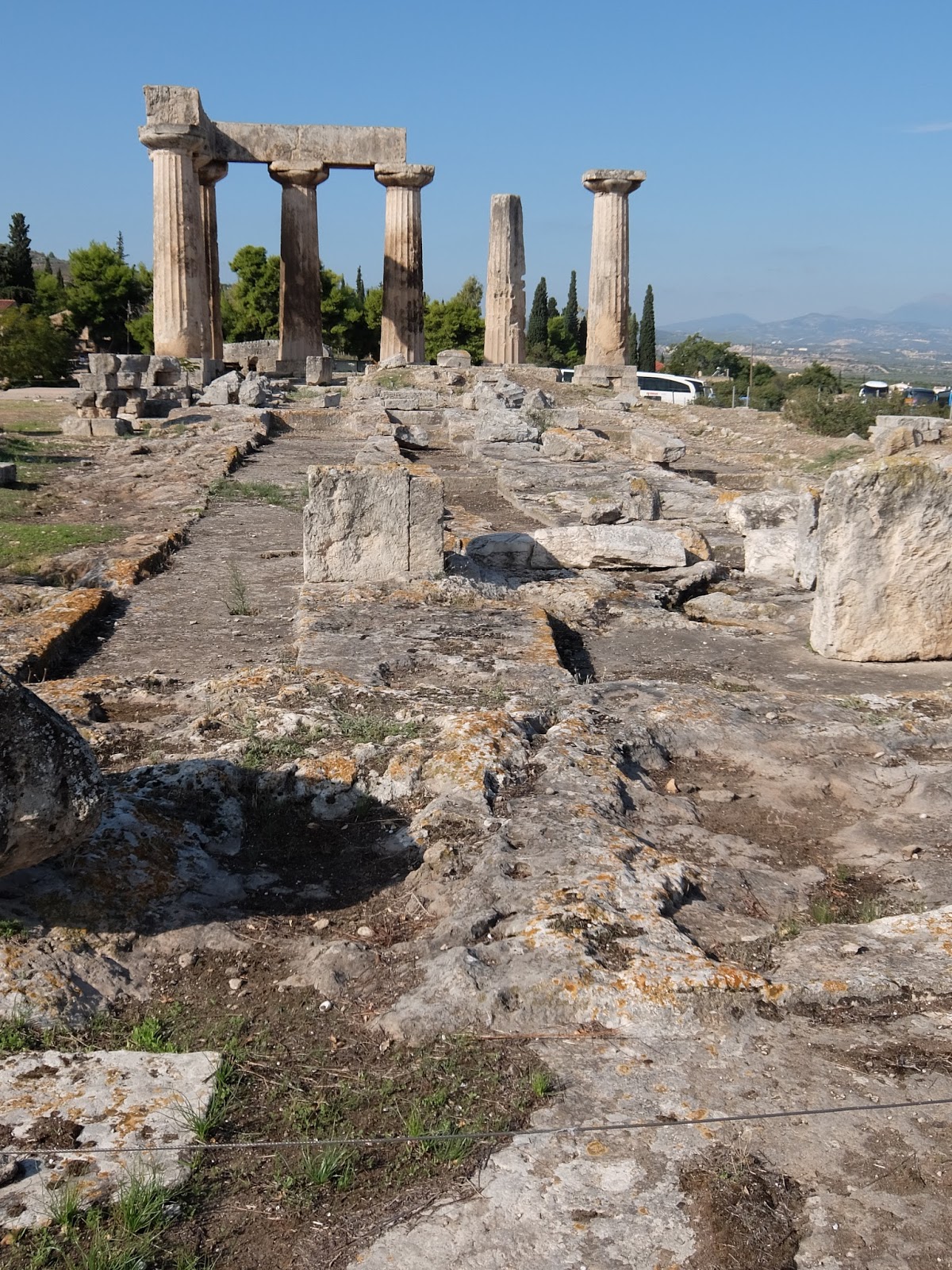
In the morning light, the columns of the Doric Temple of Apollo were standing dark against the sky, casting long oblique shadows.  I wandered slowly around them, and stood gazing out at the whole site from the ridge of higher ground the Temple stands on, and feeling a tad overwhelmed.  It is a very big area.


Only seven columns are still standing, out of an original forty-two (six on each short side and fifteen down each long side) and the majority of the cut stone has been robbed-out over the centuries

Cuttings in the bedrock show where the foundations of the Temple were

A very large site...

A van with a loud-speaker went by just as I was looking at the reconstruction on one of the interpretation signs and feeling slightly shell-shocked at the scale of it all; and a loud voice began urging people to come and buy fish.  A bit surreal, and very Greek, to be staring at ancient Roman ruins and listening to a fishmonger's megaphoned patter about beautiful sardines and anchovies...

I realised as I began to walk around just how much my memories of my one previous visit had been shaped by frustration; at myself for being lame and slow and struggling with my walking stick, and at the guide, who was fast and impatient, and mainly interested in the Apostle Paul.  I remember that I got left behind every time our group moved on.  Several times, by the time I caught up, she was already near the end of her English spiel and about to switch to Dutch; so there were some things we were taken to see where I was never quite sure what they were.  And the one place where she stopped and talked at length was at the Bema, the public speakers' rostrum where Paul is supposed to have defended himself before the Roman Consul Gallius.  I'm not a huge fan of St Paul and I was irritated by the emphasis on him.  Silly really; it's all just history and part of what has shaped our world. 

Needless to say, today I watched as groups were all taken swiftly to the Bema and it suddenly occurred to me that perhaps it isn't due to anyone being extra-keen on St Paul, so much as that he's used as a hook to get visitors here in the first place.  Ancient Corinth isn't in the front rank of really famous ancient Greek sites (I think that list probably goes; the Acropolis, Mycenae, the Theatre of Epidavros, and the Macedonian Tombs of Vergina, in that order); it isn't generally a bucket list place, though it was on mine.  A strong story like that, featuring someone you learned about in school, probably really helps the place come alive if you aren't an ancient history snob like me. 

The first coaches today arrived at around 10.00; so for the first thirty minutes I had the place virtually to myself.  Even at the height of the day there were only a dozen or so guided groups onsite.  They spread out enough that I could wander between them in a happy daze among the ancient stones baking in the sun.
 General view of the Agora, with a guided group at the Bema
Me, just wandering


Oh yes, there was plenty of sun.  It's been another really fine day, a gorgeous perfect autumnal day with blue sky, cool air and hot sun, a few brave cicadas still singing, and the leaves on the plane trees just starting to turn.

I had to keep saying to myself as I walked round "It's only Roman, it's only Roman..." because so much of the site is really open and you can walk on the ancient road surfaces, touch the ancient carved columns and capitals.  In the UK we would rush all of this stuff into a museum as soon as it was uncovered;  but then, we'd be afraid of the damp getting to it.  Here, even in the rainy season, that kind of persistent wetness just isn't a problem. 
Strolling on bits of Roman carving...


Close by to the Temple of Apollo there's an area where there was a group of little temples and monuments along the top of a slope, with steps up to each one from the Agora; the Temples of Aphrodite Genetrix, Apollo of Klaros, Herakles, Poseidon (built over a spring-house), and Tyche, the goddess of fortune, plus one that has never been identified, and a private monument to one Gnaeus Babbius Philinus, who built the little Poseidon Temple.  Pausanias mentions these in succession, just the way you find them now, as if he too went past them all in a row.  He also mentions "a sanctuary of all the gods" in the same area, but presumably no-one thinks this is the unidentified temple because it's too small for that...
On the right are the bases of the row of little Roman temples

Steps up to one of them from the Agora

I think the circular one was Gn. Babbius Philinus' monument


Spare columns kept in storage

The Romans were very keen on decorative carving - masses of it - sometimes it seems as though every possible surface was decorated.  There's a lot of it lying around as a result


Looking down between two of the small temples, into the Agora
I wandered along the great stoas, the colonnades of shops that once lined the Agora, and across the wide open space of the Agora itself, looking at the remains of a couple of the dedications there; a Heroon and a giant freestanding column. 
The South Stoa

...which housed shops, drinking houses, a council chamber, a public fountain and the headquarters of the administration for the Isthmian Games


A statue still in situ outside the Bouleuterion or council chamber


This giant column wasn't part of any structure; it must have supported a statue or other dedication; perhaps the large bronze Athena Pausanias mentions?

The "Heroon of the Crossroads"; an early Bronze Age cemetery at the meeting of the Cardo and Decumanus, the main north-south and east-west streets. It was turned into a cult sanctuary although we have no record of who was supposed to have been buried there

The Heroon with the Bema in the background

Then down to the Spring of Peirene, supposedly created when Pegasus cracked the dry earth open with his hoof.  Pausanias says the water of Peirene is sweet to drink and was also use in bronze foundries - quite what for is slightly cryptic as there's one of those infuriating bits of missing text here. 

You can't go inside the Peirene Spring, only look down at the decorative façade and the row of entrances to the public basins where people could draw water.  In the 1920s the American archaeologist Carl Blegen apparently spent a good deal of time crawling around on his hands and knees in ice-cold spring water, exploring all the passageways at the back of Peirene and mapping the sources.  There's a photograph of him in the site museum, standing at the entrance to one of the basins, barefoot and rather grubby, smoking a well-deserved cigarette. 

You can still hear the water when you stand there; it's absolutely rushing through.  Even though I wasn't able to drink from it, I can vouch that Peirene is still flowing fast through its ancient channels.

Finally I went along the marble-paved Roman road to Lechaion, which Pausanias calls "the straight road" as though that's a distinctive feature (of a Roman road?!).  It goes past the colonnade of Apollo and the Baths of Eurykles ("Corinth has plenty of baths -the best known of them... was built by a Spartan, Eurykles").  It was the Cardo of the city, the main north-south road, and according to the interpretation sign there it was still in use as a regular road right up until 1858, when it was damaged and blocked by an earthquake. 
The Lechaion Road, looking north

The Colonnade of Apollo, which probably housed more shops

The Baths of Eurykles


This monumental staircase is pretty much all that's left of the formal entrance to the road that Pausanias describes

And this is part of the road to the eastern port of Kenchreai

Corinth in ancient times had two seaports, Lechaion on the west of the Isthmus, a couple of miles away and connected to the city by a pair of Long Walls, and Kenchreai to the east.  Between the two, for good measure, ran an extraordinary thing called the Diolkos; a paved road for hauling ships over the Isthmus of Corinth between the ports.  Sadly I won't be getting to visit the remains of that, or either of the ports.  I'm almost out of time on this trip!

I was fairly tired by now, but that didn't stop me visiting the museum.  It's one of the larger ones I've been in outside Athens and unsurprisingly it has a lot of excellent Roman exhibits, including fine glasswares, mosaics, statues and portrait busts.  But also a fascinating room of prehistoric and Archaic finds from the local area, and some lovely Byzantine pottery from the settlements here in the Middle Ages.


This one is not Roman but 5th century BC

Mycenean-era pottery


And finally these two lovely bits of Byzantine ceramic; a sailing ship...

...and a loving couple
I had arrived at 9.30; I snacked late morning on some nuts and grissini, and I finally left at about 10 past 2 in the afternoon.  Staggered as far as the nearest café and was welcomed by a friendly Greek-Canadian woman who sat me down at a shady table and brought me moussaka and salad and a large ice-cold soda water.  To Tavernaki tou Gambrou; perfect lunch stop. 

It's taken so long to write Sunday up because I have been struggling to describe my visit without simply resorting to saying "Then I saw this and then I saw this and then...".  There is so much to see that it would have been quite feasible just to write a long list like that; I haven't covered everything in this description.  Corinth is amazing and should be on anyone's itinerary.  The excavated area is just a small part of the ancient city.  It must have been so splendid in its heyday...

And now Monday is drawing to a close and I still have my walk up Acrocorinth, and the tremendous castle at the top, to record!  I also need to have some supper and pack my case.  Tomorrow I move on back to Athens, for my last day here.  And on Thursday morning I fly back to London. 

That's a pretty strange thought, I must say.  This has been an amazing month.