Acrocorinth. The famous fortress, the "Fetter of the Peloponnese", which stands over Archaia Korinthos and the Roman ruins, 566 metres high (some 1800 feet in old money).

I can say it now; getting there was one of my biggest objectives, and I've accomplished it.
And it has been a wonderful day; one of those days that exceeds your wildest expectations.
I took the advice of Magdalini, the nice woman at the Tavernaki tou Gambrou café, and made an early start. Reading tripadvisor reviews and tips had just made me nervous; the sensible suggestion of someone who actually lives here was far more reassuring. Besides, now I'd told someone I was planning to do it, I was committed; I had to give it a go.
But a four km uphill walk, followed by exploring a large castle? Followed by another 4 km downhill? For a plump middle-aged diabetic who has had foot trouble in the past? I admit I was a trifle unsure whether I'd even make it to the top.
I did know however that if I walked up to the village square and took a taxi I'd always have the knowledge of having been a wimp and not even tried! 8 km is only 5 miles, after all, even if it is all hilly. Pull yourself together, Dent, I told myself.
I set off at 8.30 and was there by ten. Finally left at 1.30, had a snack at the café by the lower gate, and was back in Archaia Korinthos at around 3.40 eating a very late lunch (bifteki stuffed with cheese, and a large salad - delicious!).
So - what's the walk like, and what is there to do and see, up on the rock of Acrocorinth?
It was a lovely walk up. The road climbs steadily but never particularly steeply, it swings around the foot of the rock, slowly working upwards. I had a lovely bright morning for it, and the views got more and more spectacular by the minute. After half an hour I was taking photos, thinking "I know that soon, as I get higher, this will look like nothing - but it's so beautiful already!"


There were wildflowers in the verges and bees buzzing, and little birds flying by or sitting on telegraph wires. A kite wheeled slowly above one of the valleys on a morning thermal. There were streaks of faint high cloud in a deep blue sky, and whenever my route took me out of the shadow of the rock and into the sunlight, it was already really hot.


There was a moment when I'd been tramping steadily for a couple of hundred metres round a long curve, and I stood aside to let a car pass, and since I had paused I looked all around me. Right there, right above and behind me, was the whole of the great triple rampart and the three gateways, with all their flanking bastions and towers, backlit by the morning sun and looking like something out of a fairy-tale or a stage set. It was huge, and much closer than I'd expected; and the effect of seeing it so unexpectedly was simply magical. I stood with my mouth open for a moment and then I'm afraid I just swore.

The climb up by road to the entrance was perfectly manageable; the real hard work started once I was inside. I thought Palamidi occupied a hilly site; Acrocorinth is much, much hillier. Coming in through the third and final gate you are confronted by a kind of amphitheatre of rock and ruins, all crowned by battlements silhouetted against the sky. In the Middle Ages there was a whole small town up there, with four mosques and six churches. Now in the main there are just broken walls, and long steep paths to climb, some of them dusty and rough as goat-tracks, others cobbled, and then polished shiny-smooth. I started climbing again.




The Temple of Aphrodite was served, famously, by a long tradition of what the guidebooks call “sacred prostitution”. In English that’s a pretty unlikely yoking of concepts, and I wonder if the original words might have a slightly different nuance if one knew all their connotations. I’d certainly prefer to think of them like the Heirodules of the Devourer, in Kate Elliott’s Crossroads novels, rather than the shabby and fairly sordid image the word “prostitution” conjures up. But Corinth’s reputation was for sexual licence, at least in Roman times; it’s apparently the origin of the Georgian slang “Corinthians” for loose women...
After it was a temple, the topmost peak of Acrocorinth was occupied by a Byzantine church and then by a mosque. Now, there’s nothing up there but jumbled ruins, and I should imagine it takes a very expert eye to distinguish the remains of the different buildings. One set of foundations is at a slightly different angle to the rest, so I imagine that was the mosque. But it’s a quiet, clear remainder in visual form of the passage of time and the transience of all our systems of thought; all beliefs, all faiths and certainties, all passing in time. Everything flows, nothing is fixed.


 Eventually I geared myself up to take my own photographs. I did my first-ever 360-degree panorama (see above)
and of course a selfie.
I’ve learned my lesson since beheading my own portrait back in Athens,
and now I always check the results when I try to get a picture of myself. I managed to get two decent shots of me, and
three headless. It’s a good thing the
scenery was more photogenic than I am.

To the west, I could see out past ancient Sikyon, and over miles of the Gulf of Corinth; across the water the mountains of Boeotia receded to north and north-west, like mountains in a painting, gradually bluer and softer with each further layer of distance until they blended with the sea and I could not tell what was solid and what air, and only the faint pallor of the clouds catching on the highest peaks gave away that there was any land there at all. I was probably seeing most of the way to Delphi, had I but known where to spot it.

Directly below lay the neat street grid of modern Corinth, and the green shape of the Isthmus, with the western entry to the Canal and a small ship just coming through. If I’d been looking down in ancient times I might have seen a ship being dragged along the Diolkos; or even the teams of navvies and prisoners of war who the emperor Nero set to work trying to excavate a canal (the attempt stopped when he died; Pausanias is faintly smug about the fact the Peloponnese was still part of the mainland). To be honest the photographs really don't capture it at all...

Off the other way, east, there was the same spectacle of receding blue hills and mountains and luminous sea, plus a few islands for variety. Once people used to report being able to see the Acropolis from here, but these days the smoggy Athens air has something of a masking effect. I could tell where Athens was, but by the sight of the nifos, the cloud over the city, not the Parthenon. Beyond the cloud, the silhouetted hills sharpened again and rose, and receded slowly towards a single far high crest like a beacon hill. Could that have been Sounion?
In her great novel “The Last of the Wine”, Mary Renault has Alexias and Lysis come up here, just before the Isthmian games, and Alexias, who has good eyesight, can see both the sunlight glinting on the spear of Athena Promachos on the Acropolis, and the white columns of Sounion in the far distance. That image has always stayed with me, the two young men standing here gazing out at their world.
If you’ve never read any Mary Renault, do give her a try, incidentally. “The Last of the Wine” is not just a great historical novel, it’s also a great war story and a great love story. I know they were only fictional people, but Alexias and Lysis walked with me on this trip up Acrocorinth just the same. Just as Nikeratos (protagonist of “The Mask of Apollo”) goes with me into every ancient theatre I visit. One day, perhaps, I’ll have a Mary Renault holiday, and follow her characters’ footsteps. Though Nikeratos does get about a bit, being a touring actor; I’d need more than a month to follow him around the ancient world!


I stopped at the cafe just outside the outer gate and had a
“tost”, that eternal Greek snack food of cheese grilled between two slices of
sandwich loaf; not a great lunch, but a very holiday-ish one. Eaten in front of another magical view.

Then I walked downhill steadily for an hour and a bit. I did have slightly quivery legs by the time I was back at Archaia Korinthos. I stopped a few times; to take photos, to prospect around the site of the shrine of Demeter and Kore, once to go behind an olive tree, and once to watch a tortoise in the undergrowth on the verge. My seventh tortoise here, I think?


A great walk, a great castle, a moment of complete peace of heart; a good day.

I can say it now; getting there was one of my biggest objectives, and I've accomplished it.
And it has been a wonderful day; one of those days that exceeds your wildest expectations.
I took the advice of Magdalini, the nice woman at the Tavernaki tou Gambrou café, and made an early start. Reading tripadvisor reviews and tips had just made me nervous; the sensible suggestion of someone who actually lives here was far more reassuring. Besides, now I'd told someone I was planning to do it, I was committed; I had to give it a go.
But a four km uphill walk, followed by exploring a large castle? Followed by another 4 km downhill? For a plump middle-aged diabetic who has had foot trouble in the past? I admit I was a trifle unsure whether I'd even make it to the top.
I did know however that if I walked up to the village square and took a taxi I'd always have the knowledge of having been a wimp and not even tried! 8 km is only 5 miles, after all, even if it is all hilly. Pull yourself together, Dent, I told myself.
I set off at 8.30 and was there by ten. Finally left at 1.30, had a snack at the café by the lower gate, and was back in Archaia Korinthos at around 3.40 eating a very late lunch (bifteki stuffed with cheese, and a large salad - delicious!).
So - what's the walk like, and what is there to do and see, up on the rock of Acrocorinth?
It was a lovely walk up. The road climbs steadily but never particularly steeply, it swings around the foot of the rock, slowly working upwards. I had a lovely bright morning for it, and the views got more and more spectacular by the minute. After half an hour I was taking photos, thinking "I know that soon, as I get higher, this will look like nothing - but it's so beautiful already!"


There were wildflowers in the verges and bees buzzing, and little birds flying by or sitting on telegraph wires. A kite wheeled slowly above one of the valleys on a morning thermal. There were streaks of faint high cloud in a deep blue sky, and whenever my route took me out of the shadow of the rock and into the sunlight, it was already really hot.


There was a moment when I'd been tramping steadily for a couple of hundred metres round a long curve, and I stood aside to let a car pass, and since I had paused I looked all around me. Right there, right above and behind me, was the whole of the great triple rampart and the three gateways, with all their flanking bastions and towers, backlit by the morning sun and looking like something out of a fairy-tale or a stage set. It was huge, and much closer than I'd expected; and the effect of seeing it so unexpectedly was simply magical. I stood with my mouth open for a moment and then I'm afraid I just swore.

The climb up by road to the entrance was perfectly manageable; the real hard work started once I was inside. I thought Palamidi occupied a hilly site; Acrocorinth is much, much hillier. Coming in through the third and final gate you are confronted by a kind of amphitheatre of rock and ruins, all crowned by battlements silhouetted against the sky. In the Middle Ages there was a whole small town up there, with four mosques and six churches. Now in the main there are just broken walls, and long steep paths to climb, some of them dusty and rough as goat-tracks, others cobbled, and then polished shiny-smooth. I started climbing again.

The first gate - Venetian & Ottoman

Classical stonework at the base of the second gate (mediaeval)

Approaching the third gate (Byzantine on a Classical base)


Most of the front of the right hand tower dates from the 3rd century BC; you can see how different the masonry looks

Panorama from just inside the third gate
First of all, yesterday, I’d looked up from the ruins down below and
not quite believed I’d even get to the gate; then I’d started walking and found
it okay. But even now, when I’d got as far as the inner bailey, inside the third gate,
I saw how much further there was to climb, and for a bit I wondered if I’d
make it all the way right to the top.
The highest point of the rock, where the famous Temple of Aphrodite
stood in Classical times.
Of course I did make it.
I quartered the whole place. The
interior of the castle was so fascinating that I didn’t even think about being
tired until I’d been there a couple of hours.

The interior of the little church of Agios Dimitrios, in the inner bailey

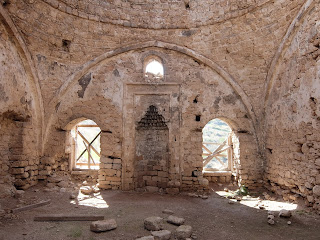
The interior of a ruined mosque

The Upper Peirene Spring was closed for renovation

And these four chaps were working there; they were trying to move a large boulder with levers and wedges, and a fulcrum made of a pile of rocks. A lot of cursing was going on

The path up to the summit (note oddly near-looking cloud!)
The Temple of Aphrodite was served, famously, by a long tradition of what the guidebooks call “sacred prostitution”. In English that’s a pretty unlikely yoking of concepts, and I wonder if the original words might have a slightly different nuance if one knew all their connotations. I’d certainly prefer to think of them like the Heirodules of the Devourer, in Kate Elliott’s Crossroads novels, rather than the shabby and fairly sordid image the word “prostitution” conjures up. But Corinth’s reputation was for sexual licence, at least in Roman times; it’s apparently the origin of the Georgian slang “Corinthians” for loose women...
After it was a temple, the topmost peak of Acrocorinth was occupied by a Byzantine church and then by a mosque. Now, there’s nothing up there but jumbled ruins, and I should imagine it takes a very expert eye to distinguish the remains of the different buildings. One set of foundations is at a slightly different angle to the rest, so I imagine that was the mosque. But it’s a quiet, clear remainder in visual form of the passage of time and the transience of all our systems of thought; all beliefs, all faiths and certainties, all passing in time. Everything flows, nothing is fixed.

Climbing higher

Almost at the top

Three different phases of masonry, all in ruins

The view north
I stood looking out, and down, and all around me, at the
view. Which was phenomenal.
I’d had a vague idea that I might have some profound
thought, if I got up here; or that I might feel moved to make some profound
prayer. In the end, neither
happened. I felt a deep calm that didn’t
take shape into anything more precise; just a kind of happy emptiness. My head was full of heat and light and
distance. I just stared.
There had been a friendly German family up there when I
arrived, taking photos and eating dried fruit, but they left fairly soon and
for the next forty minutes I just sat there on my own, looking out at the
world, in complete silence.


To the west, I could see out past ancient Sikyon, and over miles of the Gulf of Corinth; across the water the mountains of Boeotia receded to north and north-west, like mountains in a painting, gradually bluer and softer with each further layer of distance until they blended with the sea and I could not tell what was solid and what air, and only the faint pallor of the clouds catching on the highest peaks gave away that there was any land there at all. I was probably seeing most of the way to Delphi, had I but known where to spot it.

Directly below lay the neat street grid of modern Corinth, and the green shape of the Isthmus, with the western entry to the Canal and a small ship just coming through. If I’d been looking down in ancient times I might have seen a ship being dragged along the Diolkos; or even the teams of navvies and prisoners of war who the emperor Nero set to work trying to excavate a canal (the attempt stopped when he died; Pausanias is faintly smug about the fact the Peloponnese was still part of the mainland). To be honest the photographs really don't capture it at all...

Off the other way, east, there was the same spectacle of receding blue hills and mountains and luminous sea, plus a few islands for variety. Once people used to report being able to see the Acropolis from here, but these days the smoggy Athens air has something of a masking effect. I could tell where Athens was, but by the sight of the nifos, the cloud over the city, not the Parthenon. Beyond the cloud, the silhouetted hills sharpened again and rose, and receded slowly towards a single far high crest like a beacon hill. Could that have been Sounion?
In her great novel “The Last of the Wine”, Mary Renault has Alexias and Lysis come up here, just before the Isthmian games, and Alexias, who has good eyesight, can see both the sunlight glinting on the spear of Athena Promachos on the Acropolis, and the white columns of Sounion in the far distance. That image has always stayed with me, the two young men standing here gazing out at their world.
If you’ve never read any Mary Renault, do give her a try, incidentally. “The Last of the Wine” is not just a great historical novel, it’s also a great war story and a great love story. I know they were only fictional people, but Alexias and Lysis walked with me on this trip up Acrocorinth just the same. Just as Nikeratos (protagonist of “The Mask of Apollo”) goes with me into every ancient theatre I visit. One day, perhaps, I’ll have a Mary Renault holiday, and follow her characters’ footsteps. Though Nikeratos does get about a bit, being a touring actor; I’d need more than a month to follow him around the ancient world!
In the end I did say a prayer, and I poured a small
libation, though I only had water to offer.
It seemed inappropriate not to, in a place of such ancient sanctity, and
one that was never as it were on the high street, never easily
popped-in-to. I tipped out some of my
water, and then drank a little myself, and I gave thanks to whatever are now
the spirits of this place; for this trip, for everything that is beautiful and
interesting about the world, for all the good people I’ve met and all those
I’ve known in the past, including those who could no longer be there with me
except in my mind. Finally I said “Thank you for my life” and I felt as full as
I’d felt empty a few minutes earlier.
Seeing it written down, now, I think “Crikey, that looks as
though I think I’ll be dead soon!” – and it isn’t like that at all. I feel a lot more alive than I did a year
ago, and ready for whatever comes next in a way I haven’t done in years. And I am grateful and glad of this, and
grateful beyond measure for this life, pathless though it has been at times and
difficult. I have seen and done so much
with my time. I’m likely well past my
mid-point in life. It seemed right to
give thanks, for all the road so far.
On the way down I passed a group of trees, short,
wind-shaped things that appeared to be dead; and I suddenly noticed that in
fact they all had tiny buds, just starting to swell and go green, in the axil
of every twig and leaf joint. Once
again, there’s that miracle, all the life returning now the rains have
come. It never ceases to move me.


At the third gate, on the way down

Then I walked downhill steadily for an hour and a bit. I did have slightly quivery legs by the time I was back at Archaia Korinthos. I stopped a few times; to take photos, to prospect around the site of the shrine of Demeter and Kore, once to go behind an olive tree, and once to watch a tortoise in the undergrowth on the verge. My seventh tortoise here, I think?

Looking up again as I leave

Of course a photo can't capture the wonderful smell of a fig tree in full sunshine...

Olive groves in the afternoon sun

A great walk, a great castle, a moment of complete peace of heart; a good day.