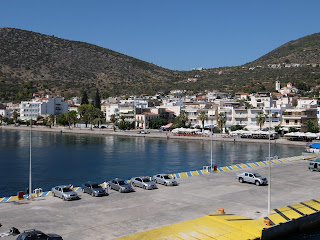
12 noon. Piraeus.
On board the
Nova Lines ferry Phoibos, leaving
Piraeus. Passing the quarry-scarred
coast of Salamis to starboard.
The island of Salamis and the straits where the famous naval battle of 480 BC took place
The
extraordinariness of using those potent historical names in a casual sentence
like that! This is a huge busy modern
harbour I’m leaving; but it was the ancient harbour town of Athens and the base
for the great naval fleet that made her such a big regional power player. Salamis over there – or to be precise, this
channel of deep blue water between there and the mainland – was the site of one
of the most important battles of ancient history, the defeat of the Persian
invasion fleet in 480 BC. They’d invaded
once already ten years earlier, and been turned back at Marathon, pretty much
as soon as they landed, and then they’d turned up again a bare decade later. How people here must have feared they’d just keep
on coming until they got what they wanted...
But their fleet was pretty
much completely destroyed in the channel off Salamis, probably at about this
time of year; their land forces were forced to withdraw from Athens and
overwinter in the countryside, and were crushingly defeated again a few months
later at Plataea. And they never came
back.
The story is that the playwright Aischylos fought as a youth
at Marathon and again as a mature man on a ship at Salamis; and Socrates fought
at Plataia. History at my fingertips; or
rather, off my starboard flank.
The sky is a clear bright blue with a handful of fluffy
white clouds, and the sea is deep indigo and marvellously calm. Ahead of the ship, Aegina is a strong blue
silhouette on the horizon.

I feel ridiculously excited at being on my way to my next
destination. There’s something magical
about sea travel. The fresh breeze and
the brightness, the clean air, the sense of moving through a vast space of
ocean. A big cargo ship called the Opal Leader just went past, heading into
Piraeus with a pilot boat chugging ahead of her. Now we’re approaching the “ships’ graveyard”
where laid-up merchant ships lie at anchor waiting to be brought back into
service or broken up. Some of them look
as though they haven’t moved int eh twenty-some years since I last passed this
way. But others look clean and
ship-shape, as though they might be ready to go at a couple of days’
notice. We pass one, the Ceyla K, port of registry Istanbul, with
cargo containers on board; another, further off, has a tender lying alongside.
I suddenly remember I have my binoculars with me. Once I’ve got those out I can see more
names. The Panagia Armata of Valetta; the Independent
Venture of Monrovia; the Gianni
of Valetta; the Sea Rambler, also of
Valetta, listing astern and with pumps going steadily. There are perhaps 15 or 20 ships out here
altogether.
As far as the eye can see, beyond the coloured hulls
scattered over the channel, otherwise almost the only colours are blue and
white. Blue sea and sky, blue
silhouettes of land in the midday light; white puffs of cloud and white wake in
the water behind us, and white ship’s rail and superstructure. It’s like sailing across a giant Hellenic
flag.
All blue and white, bar the red of the starboard funnel
Salamis is falling astern now, and
beyond that are the high peaks of the mainland, mountains along the approach to
the Isthmus of Corinth. That was Theseus’
road, where he had so many adventures on his way to meet his father. The land falls away eventually and then rises
again; and that is the Peloponnese. I
can already see the unmistakable outline of the Methana peninsula, sharp-cut
and mauve-blue like an amethyst.
A Hellenic Seaways hydrofoil passes by, overtaking us, going
south. I much prefer being on board an
old-fashioned open-decked ferry, romantic idiot that I am! Well, the fresh air is a plus, for starters;
the hydrofoils are fast and efficient, but it is rather like being on board a
large bus.
Little rocky islets to starboard now; a tiny chapel with an
open belfry on one. A fishing boat at
anchor, a few yachts scudding along. The
north coast of Aegina is to port, and getting quite close already. We’ve acquired several gulls, about ten in
all, coasting alongside us on the breeze, barely twitching their wings as they
loop up and over, fall back, and swoop by again. A single dark shearwater goes by, heading the
other way, long slender wings glancing on the waves. Oh there is nothing like being at sea!
An escort of seagulls
Coming round the point; I can see Cape Colonna, and the
hotel where I stayed 25 years ago; and the beach where Mum and I had a rather
rough-and-ready picnic one December day a couple of years after that.
Coming into harbour at Aigina Town
Cape Kolonna
And there are the clear remains of the quays of the ancient military harbour, showing through the water. According to
Pausanias this was one of the most unapproachable islands in the Aegean, hemmed-in with shoals and reefs, created somehow at the contrivance of their legendary king Aiakos to keep the island safe from pirates and the like. The reefs
today are from those half-submerged ancient harbour walls; there’s just one
clear deep-water channel going in through them.
Reefs formed by the submerged walls of the ancient harbour, below Cape Kolonna
Later; 1.20 pm.
Ekonomou Bros Taverna, on the harbour.
And I’m here. I’ve
ordered some lunch and another bottle of water.
It’s boiling hot and there’s traffic going by, cars and trucks, farty
little mopeds, a cantankerous-sounding tractor.
The inner harbour is crammed with yachts. All the cafes and restaurants on the front
are full of people eating. It’s all busy
and noisy and lively, and very Greek.
My briami is delicious.
It’s a mess of baked vegetables; it’s basicaly what my Mum makes, that
she calls veg pot; only hers has lentils as well. If she were the mamma in a Greek restaurant
kitchen then they would serve briami me fakes.
The Phoibos is
tied up at the quay. She docked at 5
past 1.00. A bright green hydrofoil was
also in port when we arrived, but that has just honked its hooter and departed.
When was it I first came to Aegina? I’m pretty sure it was in May, either 1990 or
’91. I had a gammy leg, because a week
previously I’d been ASM-ing for a production of “The Merry Wives of Windsor”
and had fallen on stage and very nearly broken it. I travelled with a cane and could barely
hobble down to meals in the hotel, the first few days. It was about day four before I ventured as
far as the steps down to the beach, and managed to get in the water and swim a
little.
I’d be lying to myself if I pretended this trip wasn’t
partly about looking back on myself as I was in the past. Greece
has changed in the years I’ve been coming here, and so have I; in fact, in my
life, Greece, and my longing for Greece, has been one of the most consistent
things. So much else has come and gone,
jobs, friends, boyfriends, art school, all sorts of hopes and plans, and a lot
of mistakes, have all passed by, but Hellas has remained, and knowing this
beautiful civilised country was still here and could be returned-to has made me
very happy. I have so many wonderful
memories of visits to Greece.
I wanted so much to come here as a girl. Reading Classical mythology, and then doing
Latin and Classical Greek at school, I dreamed of seeing the places I was
reading about. All those legendary
heroes and heroines, all those historical wars and leaders, all seemed
incredibly vivid to me. I devoured Mary
Renault’s novels, and Peter Green’s, and anything else I could find that was
set in ancient Greece.
But I wasn’t a natural academic. The idea of spending my life studying and
translating the literature of ancient Greece didn’t really do anything for
me. What I wanted was to be here; to touch the places those
historic people had touched, walk upon the roads they trod. I wanted a sort of experiential contact with
that magical past I’d read so much about.
Looking out at the Straits of Salamis earlier I could imagine the Allied
triremes manoeuvring, their oars flashing in the sun, and the big enemy ships
struggling in the confined space and unfamiliar waters. It was a potent thought.
And what on earth would European history have been like if
those Greek alliances hadn’t turned back the Persian Empire, in 490 and again in
480 BC? The Persians were wildly
expansionist, I’m fairly sure they wouldn’t have stopped here...
I love history
because it is real, it’s made the world we live in now, it’s made the
circumstances of every aspect of our lives.
It isn’t a dry subject, I could never have sat and studied it in an
office. I need to be here and see the
same light those people saw.
Ekonomou Bros, incidentally, is the very same taverna I used
to eat in 25 years ago, when I got mobile enough to toddle into town from my
hotel. A lovely couple staying there at
the same time, named (I think) George and Mary, recommended it to me. It was at George’s urging that I tried Greek
giant baked beans, gigantes plaki,
for the first time. Start of an
addiction!
I met Leena Pykko here, too, up on Cape Kolonna by the
Apollo temple. She was a fascinating,
articulate Finnish-Canadian with a great sense of humour. We corresponded for several years. I wonder what happened to her? She was a couple of years older than me. I know she married another Canadian, and they
settled in Corfu eventually and opened a pizzeria; I know she wrote a play,
which was performed there in Corfu a few years later. But then we lost touch. I hope things went well for her and Roberto.
As for George and Mary, they were in their sixties when I
met them; so they’re going to be pretty elderly now, if they’re still
alive. Well, I salute their memory! They were kind and friendly to a rather lost,
lame young woman toddling about on a stick, who they could very easily have found
funny or peculiar, and their encouragement and enthusiasm for everything meant
a lot to me.
So anyway, to conclude this latest batch of rambling; this
trip is about more than Pausanias. I’m
retracing some of my own journeys, as well as his, rediscovering places I’ve
known many years ago, and remembering the inexperienced and cripplingly shy
creature I was then. But I’m also doing
something she wanted to do, travelling with an ancient guide and trying to
match what I see and find to what he found and what he saw. It has a nice circularity, when I think about
it.
The town beach; my early afternoon swimming spot
And the view from my balcony at sunset